American History X (1998)
A 1998 drama about a former neo-Nazi gang leader released from prison and his younger brother who is being radicalized by the same gang while the leader was inside. The film is honest about the pull of the ideology even on people who have rejected it, and the honesty is the part the film is for.
What the film does
The film is set in 1997-1998 in Venice Beach, Los Angeles. Edward Norton plays Derek Vinyard, the older brother, who was the leader of a white-supremacist gang called the Disciples of Christ (D.O.C.) and is released from prison on the day his younger brother Danny (Edward Furlong) is given an ultimatum by the school principal and outreach worker Dr. Bob Sweeney (Avery Brooks). Danny has antagonized his Jewish history teacher by writing an essay on Mein Kampf. Sweeney’s deal: write a paper on Derek for a class called American History X, or be expelled.
The backstory, told in flashbacks, is that Derek and Danny’s firefighter father was shot and killed by a drug dealer while extinguishing a fire in a majority-Black neighborhood. Derek has a televised racist outburst at the funeral. A neo-Nazi mentor named Cameron Alexander takes Derek under his wing, and Derek builds the D.O.C. into a violent gang. The D.O.C. attacks a local supermarket employing illegal immigrants, plays basketball against a group of Crips for the territorial rights to a Venice Beach court, and Derek ends up killing one Crip and curb-stomping another during a truck-theft attempt. He is sentenced to three years.
In prison, Derek joins the Aryan Brotherhood but is abandoned by the D.O.C. outside. He befriends a Black inmate named Lamont, his assigned co-worker in the prison laundry, and gradually realizes the Aryan Brotherhood is just a criminal gang using white supremacy as a facade. The Brotherhood beats and gang-rapes him in the communal shower in retaliation. Sweeney visits, rebukes Derek for wanting to avoid consequences, and reveals his own racist past, telling Derek that Danny is being indoctrinated by the D.O.C.
The present-day material follows Derek’s attempt to pull Danny back from the D.O.C. He confronts Cameron at a compound party, beats him, and is attacked in return. He and Danny remove the neo-Nazi posters from their shared bedroom. The next morning, in the school bathroom, the same Black student Danny had confronted the day before shoots Danny dead. Derek runs to the school, cradles Danny’s body, and blames himself. The film ends with Danny’s voice reading the final lines of his paper, quoting the final lines of Abraham Lincoln’s first inaugural address.
The film uses black-and-white for Derek’s flashbacks and color for the present day.
Why it’s in the canon
Criteria blend is 1+3, loved it and want to remember it. The film is the rare mainstream drama that takes the audience inside a white-supremacist worldview long enough to make the rejection feel earned rather than assumed. Norton’s performance is the through-line: the film follows Derek from a charismatic gang leader through prison and out the other side, and the work is in the change, not the static version. The film does not sanctify Derek, and the film does not demonize the audience for following him. The film asks the audience to do the same work the film is doing, and the asking is the part the film is for.
The film pairs with other 90s dramas in the canon that deal with the failure of inherited belief. The film is also a film that was contested on release and that has only gotten more relevant with age, and the more-relevant-with-age is the kind of thing the canon wants to hold.
A note on the year
The film is 1998. The Wikipedia and Letterboxd pages both list 1998. We use 1998.
A note on disambiguation
This is the 1998 Tony Kaye film starring Edward Norton. There is no other feature film of this title.
A note on the image
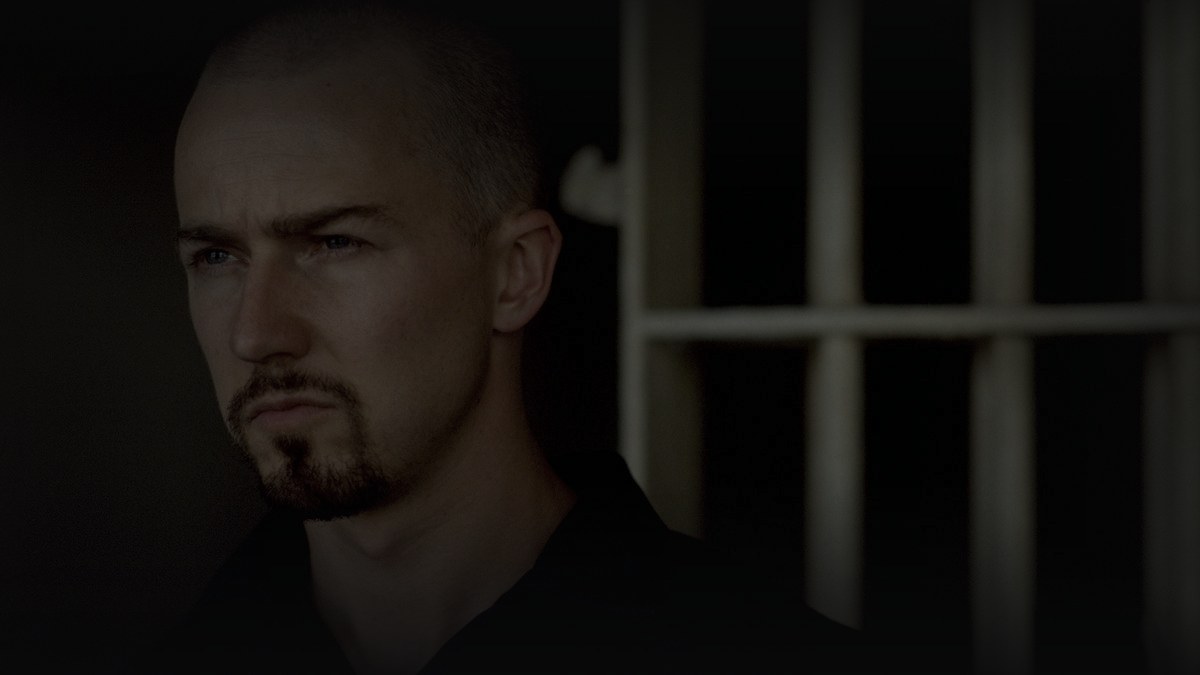
The hero image is the canonical Edward Norton prison still, in black and white, in front of bars. The bake pushes the source brightness down a bit further because the source is already dim, but the result is still in canon range and the film is darker than the canon’s average for a reason.
On hand
No. This is a wishlist entry. The film is widely available on home video and the major streaming platforms.
image: 16:9 still from Letterboxd (the 1200x675 crop variant), baked through scripts/bake_dark_photo.py at default factor, mean brightness 22.3 (in canon range, on the dim side for the black-and-white flashback aesthetic of the source still). source: edward norton as derek vinyard, in prison, in front of bars - the canonical still for the film.