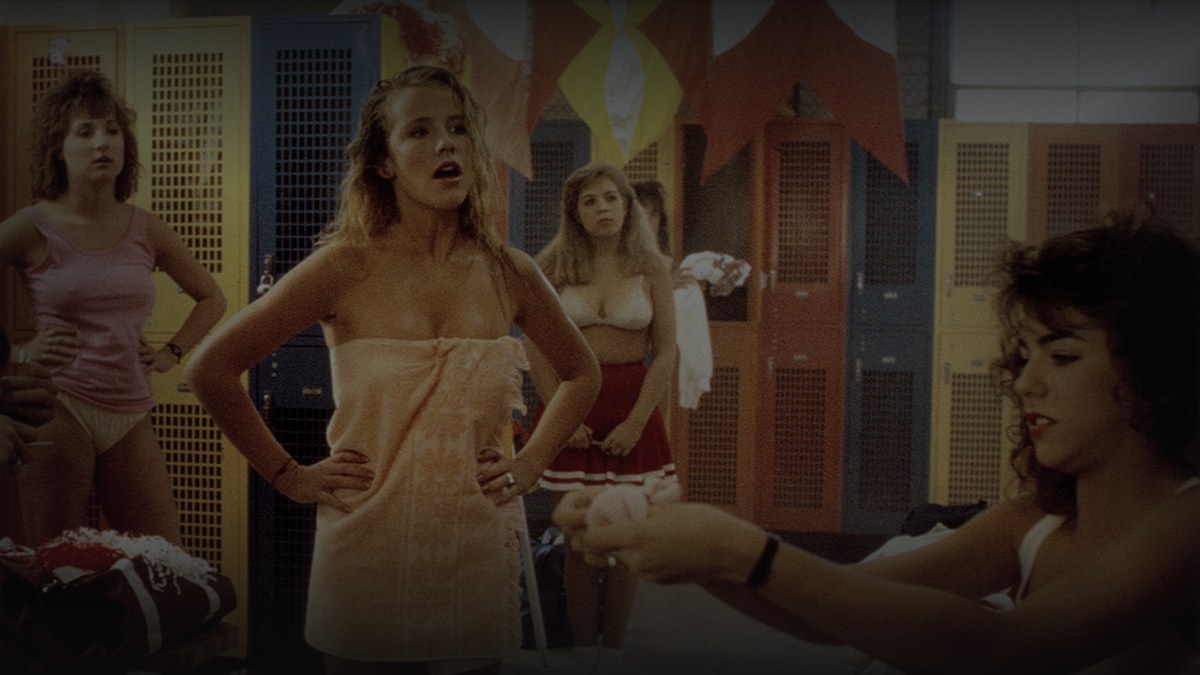
Can’t Buy Me Love (1987)
A 1987 teen romantic comedy about a high-school nerd who pays the popular girl to pretend to be his girlfriend, and the deal going exactly the way the audience fears it will. The film is honest about the cost of the deal, and the honesty is the part most teen rom-coms of the era were not willing to pay.
What the film does
Patrick Dempsey plays Ronald Miller, the nerd, a smart and underappreciated kid in a suburban high school. Amanda Peterson plays Cindy Mancini, the popular girl, a cheerleader who needs money to replace her mother’s borrowed-and-ruined suede outfit before her parents notice. The deal is $1,000 for a month of public dates. The deal gets Ronald into the popular crowd, gets Cindy the money, and changes both of them in ways neither of them predicted or wanted.
The film is sharp about what the popular crowd actually is, which is not glamorous, it is petty and small and the popularity momentum is fragile and turns on the smallest things. The film is sharp about what the nerd crowd actually is too, which is a real group of friends and not just a collection of rejects. The two groups are not as far apart as the genre usually pretends. The film knows this and lets the audience know it. The knowing is the movie.
The third act is the break, and the break is real, the film does not flinch. The break is the moment the deal stops being a deal and starts being an injury, and the film takes the time to let the injury breathe before the reconciliation. The reconciliation itself is earned, not by a grand gesture but by Ronald being willing to be the nerd in public for the sake of a friend. The film commits to the earn. The earn is the whole third act.
The cast is good. Dempsey is good in a way that does not look backward toward the romantic lead he would later become in the 1990s. He is playing a 17-year-old and he is not trying to be older than the part. Peterson is the better performance, the popular girl who is allowed to be more than a mean girl, who is allowed to be lonely and unsure, who is allowed to be a real character inside the genre the genre usually does not let her be in. Seth Green plays a small role as Ronald’s best friend and gets more out of the small role than most actors get out of the lead.
Why it’s in the canon
Criteria blend is 1+3, loved it and want to remember it. A fun comedy that is relevant to the 80s, the era it is set in and the era that made it, the era of the mall and the suede outfit and the deal and the price. The era is the texture of the film, the film is not a period piece about the 80s, it is an 80s film, and the difference matters. The film was made in 1987 by people who were 17 in 1987 and the film knows what that felt like and the film tells the audience.
The film is a romance, the romance is a teenage one, and the teenage one is allowed to be the whole movie without an adult subplot or an adult framing device. The film is not a John Hughes film, the Hughes films are from the same era and the comparison is unavoidable, but the Hughes films are about kids in an adult world, and this film is about kids in a kid world. The kid world is the rarer movie, and the rarer movie is the one the canon wants.
A note on the year
The film is 1987. The Wikipedia article calls it 1987. The Letterboxd page calls it 1987. We use 1987.
A note on disambiguation
This is the 1987 Steve Rash film starring Patrick Dempsey and Amanda Peterson. There is no other feature film of this title in the same year. The Beatles song of the same title is the film’s title source; the song appears in the film.
On hand
Yes, DVD + digital. The DVD is the Buena Vista release. The digital copy is the same transfer, no extras.
image: 16:9 still from Letterboxd (the 1200x675 crop variant), baked through scripts/bake_dark_photo.py at default factor, mean brightness 32.1 (in canon range).