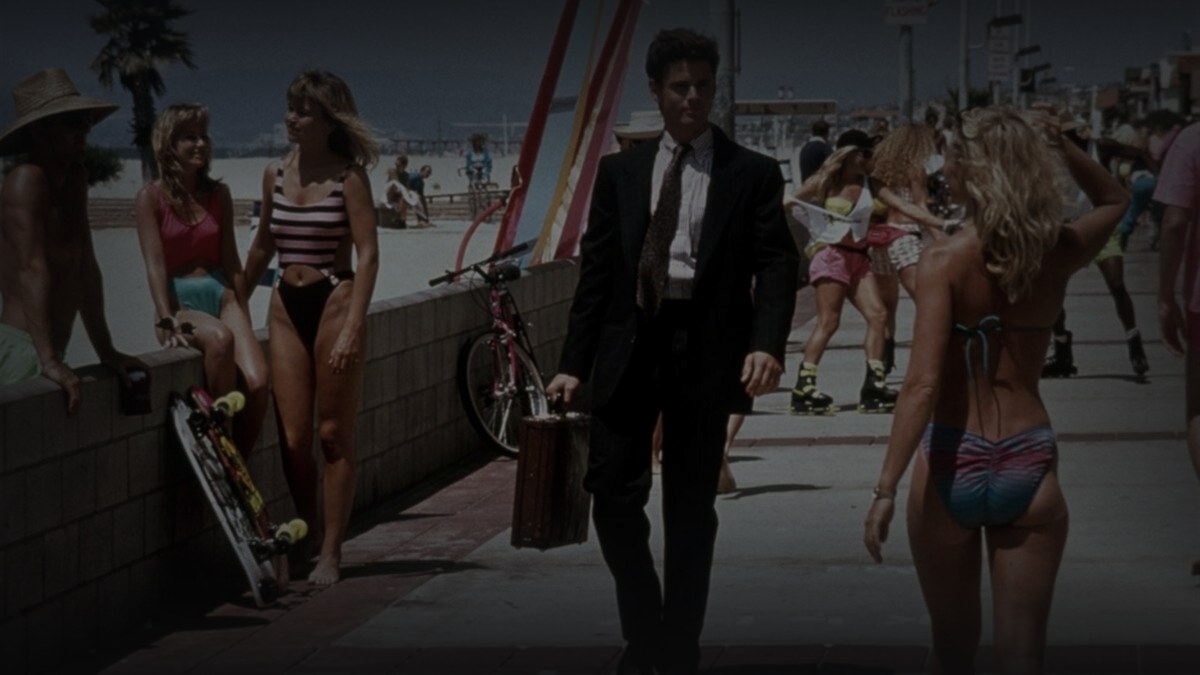
Side Out (1990)
A 1990 beach-volleyball film about a guy who has to relearn the sport he used to play, who has to learn it fast, and who has to learn it with a partner who is not the partner he wanted. The film is honest about the partnership, and the honesty is the part most 90s sports films were not willing to pay.
What the film does
C. Thomas Howell plays Monroe Clark, a former college volleyball player who has not played the sport in years, who is working a dead-end job as a law clerk, and who is sent to los angeles to help a former coach with a legal matter. The coach is dying. The coach asks Monroe to do one last thing for him, which is to play one last beach-volleyball tournament, which is the coach’s last chance to win the thing he never won. The film is interested in the ask, in the ask as a request from someone who is dying, and in the ask as the kind of request that is hard to say no to.
The partner is not who Monroe wanted. The partner is a local, played by Peter Horton, who is the kind of volleyball player who is good at the sport and bad at the rest of life. The film is interested in the partnership as a partnership, in the work of being partners, and in the part of the work that is the opposite of the kind of partner each one wanted. The film is also interested in the women, played by Melora Hardin and Courtney Thorne-Smith, who are not the girlfriends the genre usually picks. The women are allowed to be real characters with real reasons for being on the beach, and the reasons are not the reasons the genre usually gives.
The third act is the tournament, and the tournament is the place the film is heading, and the tournament is the place the film delivers. The film commits to the tournament, and the commitment is the part most 90s sports films of the beach-volleyball type were not willing to pay. The film does not cheat the sport, and the not-cheating is the reason the film is in the canon.
Why it’s in the canon
Criteria blend is 1+3, loved it and want to remember it. A 90s beach-volleyball film that takes the beach-volleyball part seriously. The film is interested in the sport, in the way the sport is played at the highest level, and in the way the highest level is not what the genre usually shows. The film is also interested in the los angeles of the era, in the venice beach of the era, and the los angeles is the place the film is set. The setting is the film.
The film is also a C. Thomas Howell film. The film is not the most ambitious Howell film. The film is a Howell film that lets Howell be the Howell of the era, which is to say the Howell of the era is good, and the Howell of the era is the version of Howell the canon wants. The Howell of the era is the Howell of the 80s and early 90s, and the canon is for the films where the era’s people are good.
A note on the year
The film is 1990. The Letterboxd page is the 1990 film. We use 1990.
A note on disambiguation
This is the 1990 Peter Israelson film starring C. Thomas Howell. There is no other feature film of this title in the same year.
On hand
Yes, DVD only. No digital copy. The DVD is the Paramount release.
image: 16:9 still from Letterboxd (the 1200x675 crop variant), baked through scripts/bake_dark_photo.py at default factor, mean brightness 41.2 (in canon range, slightly above the 25-35 target but appropriate for a bright sunlit beach-boardwalk still).