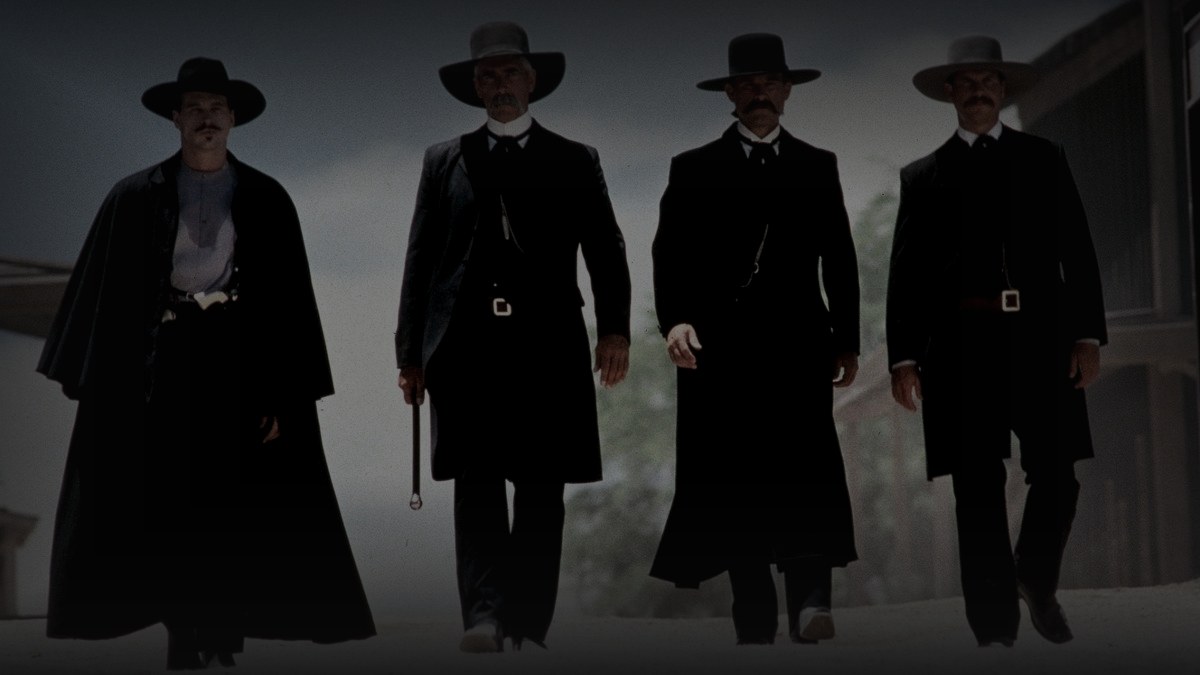
Tombstone (1993)
A 1993 western that took the Wyatt Earp / Doc Holliday / O.K. Corral story and made it work as character drama, which the genre rarely does. The film is more interested in the men than the gunfights. The gunfights are extraordinarily good, but they earn their weight by being the resolution of personalities that the film has been quietly building for the first hour.
What the film does
Kurt Russell plays Wyatt Earp as a man who has already seen everything and is mostly trying to be left alone. He has retired to Tombstone, Arizona, in part because his brothers need a fresh start and in part because he is tired. The film opens with him refusing to use his gun even when he is well within his rights to. Val Kilmer plays Doc Holliday as the only person more tired than Earp, except Doc has made a performance of his tiredness, and the performance is what keeps him alive. The two men become friends in the way men of a certain age and certain history become friends, with silence, with one drink too many, with the willingness to say the unsayable thing and move on.
The conflict is the Cowboys, a loose band of former Confederate irregulars turned rustlers, led by Curly Bill Brocius (Powers Boothe) and the gentler, more dangerous Johnny Ringo (Michael Biehn). They are recruited by the Earp side at first, then betrayed, then the betrayal moves through the Earp family and ends at the O.K. Corral. Sam Elliott plays the older Earp brother Virgil as the moral center of the film. Bill Paxton plays the youngest brother Morgan. Dana Delany plays the woman who, in the real history, was a common-law wife; in the film she is a working woman with a past, which is closer to the truth than the common-law-wife framing makes it sound.
The third act, after the gunfight at the O.K. Corral, is the part the film is most remembered for. It is the Earp vendetta ride, a real historical event that the film treats as a slow burn of retribution. The Cowboys die one by one. The film takes its time with each death. The pacing is closer to a procedural than to a western. The film trusts the audience to feel the weight of each killing, and the weight is considerable.
Why it’s in the canon
Great tale of the wild west that is somewhat historically accurate. The criteria blend is 1+3, I loved it and I want to remember it. It is the rare western where the men talking are more compelling than the men shooting, and the men shooting are still the best in the genre. The script (by Kevin Jarre, who was fired during production but whose dialogue survived) has the quality of a writer who has lived with historical sources long enough to internalize the speech patterns of the era. The dialogue sounds like 1881, not like a Hollywood writer’s idea of 1881.
A note on history
The film is somewhat historically accurate, not strictly so. The real Wyatt Earp was a more ambiguous figure, and the real Doc Holliday was a dentist from Georgia dying of tuberculosis who drifted west for his health. The film romanticizes both. The Earp brothers’ vendetta ride did happen; the film gives it more dramatic shape than the historical record supports. The Ike Clanton of the film is a stock villain; the real Clanton was a cattle rancher with political ambitions, not a coward. None of this is a problem. The film is a western, not a documentary, and the choices it makes are in service of the story. The best westerns do this.
What stays with me
Val Kilmer’s Doc Holliday. The performance is one of the great supporting roles in 1990s American film. The cough, the jokes that are also not jokes, the way the character carries a terminal diagnosis as though it were a personal assistant. The film spends more time on Doc than on the historical record justifies, and the extra time is exactly where the film finds its soul.
On hand
Yes, DVD + digital. The DVD is the Buena Vista release. The digital copy is the same transfer, no extras. If you only know the film from clips or from the “I’m your huckleberry” line, watch the full film at least once. The line is the punchline to a setup the film takes forty minutes to build.
A note on the title
This is the 1993 film directed by George P. Cosmatos, with Kevin Jarre’s uncredited screenplay. There is a 2022 docuseries called Tombstone: The New West that is unrelated.
image: still from Tombstone (1993), dir. George P. Cosmatos, via Letterboxd